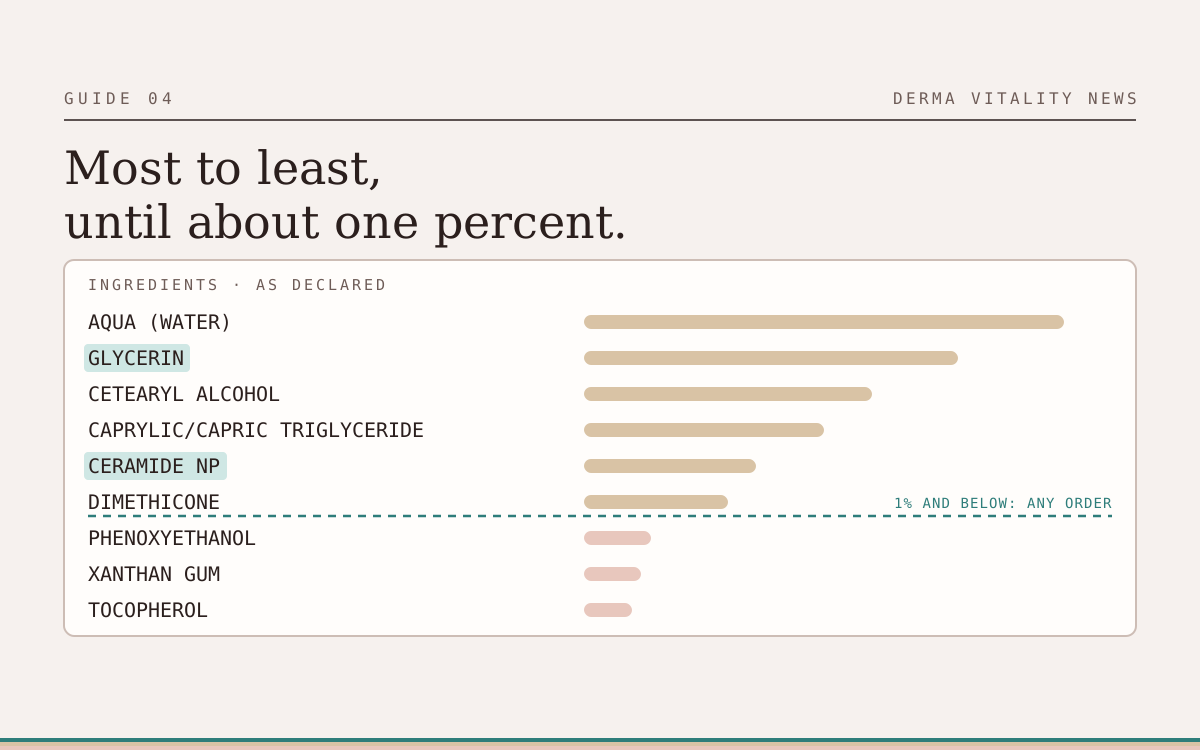
An ingredient list is a ranking, not a recipe. On a US cosmetic label, ingredients generally appear in descending order of predominance, so the first few names make up most of the product. Near the bottom, the rules let the order go loose, and no percentages are required at all [1]. This guide covers the rules that shape the list, then walks through a real one.
Where the list comes from
The FDA requires an ingredient declaration on cosmetics sold at retail to consumers, including online and person-to-person sales, under the Fair Packaging and Labeling Act [3]. The detailed rule is 21 CFR 701.3 [1]. A few practical consequences:
- It's on the outer package. The list can be on any information panel, such as the carton, or on a firmly attached tag, tape or card, in letters at least 1/16 inch tall (1/32 inch on very small packages) [4].
- Online orders can point elsewhere. For mail-order sales, the package may instead tell you where to find the list, such as a catalog, which the FDA currently reads as including a website [3].
- Not every product needs one. Free samples and products only for professional or institutional use are outside the requirement [3].
- Brand web pages can lag the box. Formulas change, and some brands say so on the page. When a web list and a box disagree, the box in your hand describes the product in your hand.
What the order tells you, and where it stops
The basic rule is descending order of predominance [1]. The rule also allows a grouped format, and it changes how far down you can trust the ranking [1][2]:
Above 1 percent
Ingredients present at more than 1 percent, other than color additives, come first, in descending order.
1 percent or less
Ingredients at 1 percent or less follow, in any order.
Color additives
Color additives come last, in any order, at any concentration.
The label doesn't mark where the 1 percent zone begins, and it isn't required to show percentages. So the order tells you roughly what dominates the formula, but you can't use it to rank two ingredients near the end or to guess how much of anything is in there. When a brand puts a percentage in the product name, that is the brand's own statement.
Why the names look strange
US rules require each ingredient to be named by a name the FDA has established, or failing that, the name adopted in a set of reference books the regulation lists in order, starting with an industry cosmetic ingredient dictionary [1][2]. In practice most labels use standardized cosmetic ingredient names, often called INCI names (International Nomenclature of Cosmetic Ingredients). That's why a label says "Butyrospermum Parkii (Shea) Butter" or "Tocopherol" rather than something friendlier.
The FDA requires the common or usual name in English. It doesn't accept an EU term on its own, such as "Aqua" for water, "Parfum" for fragrance, a Latin botanical name alone, or a "CI" number alone for a color. It doesn't object to those in parentheses after the English name, and gives examples like "Water (Aqua)," "Fragrance (Parfum)" and "FD&C Yellow No. 5 (CI 19140)" [3]. Plant ingredients follow the same pattern; the FDA's example is "Sweet Almond (Prunus Amygdalus Dulcis) Oil" [3]. On a web page or a box printed for several markets, you'll often see the EU term first, as in "Aqua (Water)." Either way, it's the same ingredient.
To look up an unfamiliar name, the European Commission's CosIng database is free and searchable. Its entries give the ingredient name, its chemical description where available, and the functions reported for it in cosmetics, such as solvent, humectant or preservative [5]. A function tells you the job an ingredient can do in a formula. It doesn't tell you what the product will do for your skin.
The exceptions that change what you see
- "Fragrance" or "Flavor." A fragrance or flavor blend may be listed as a single word [1]. See our guide to fragrance-free vs. unscented.
- "And other ingredients." If the FDA has accepted an ingredient as exempt from public disclosure, its name can be replaced by this phrase at the end of the list [1].
- Incidental ingredients. Substances present at insignificant levels with no technical or functional effect in the finished product, such as certain processing aids, don't have to be declared [1].
- "May contain." This phrase is allowed for color additives, for example ones added to some batches for color matching, or ones shared across a line of shaded products [1]. You're more likely to meet it on makeup than on skin care.
- Products that are also drugs. A sunscreen, or a moisturizer with an SPF claim, lists its active drug ingredients first, followed by the cosmetic (inactive) ingredients [1][2]. On those products, read the Drug Facts panel; our sunscreen label guide covers it.
A worked example
Example only: the ingredient list The Ordinary prints on its US product page for Niacinamide 10% + Zinc 1%, read on Sep 30, 2026. The brand notes on that page that the list may vary from the box depending on time and region of purchase [6]. Our full entry for this serum covers the product itself.
Aqua (Water), Niacinamide, Pentylene Glycol, Zinc PCA, Dimethyl Isosorbide, Tamarindus Indica Seed Gum, Xanthan Gum, Isoceteth-20, Ethoxydiglycol, Phenoxyethanol, Chlorphenesin.
Marked = discussed below11 ingredients listed
Here is how to read it, in order.
Count and read the top 10 sec
Eleven ingredients, which is short. Water comes first, so it's the largest component. Niacinamide is second, which fits the 10 percent the brand puts in the name. CosIng lists one function for niacinamide in cosmetics: smoothing [5].
Find the named ingredient 10 sec
Zinc PCA is fourth. The name says "Zinc 1%," but the label doesn't say whether that means 1 percent zinc PCA or 1 percent zinc, so we don't read a precise amount into its position. CosIng lists it as a humectant and skin-conditioning ingredient [5].
Identify the working parts of the base 20 sec
Looked up in CosIng: pentylene glycol (skin conditioning, solvent), dimethyl isosorbide (solvent, viscosity controlling), tamarind seed gum and xanthan gum (emulsion stabilizing, viscosity controlling, among others) and isoceteth-20 (emulsifying and cleansing surfactant) [5]. Together they're the base that carries the two named ingredients.
Find the preservatives 10 sec
Phenoxyethanol and Chlorphenesin close the list; CosIng lists both as antimicrobial and preservative [5]. If you've reacted to a specific preservative before, this is the part of the list to check.
Check what isn't there 10 sec
No "Fragrance," "Parfum" or color additive on this list. Absence on a web list is worth confirming on the box, for the reason the brand itself gives.
Notice what the example doesn't tell you: how much of anything past the second ingredient is in the bottle, or how it will feel on your skin. Those questions need the brand's own statements or trying the product. Our patch-test guide covers the careful way to do that.
If you've reacted to a product and can't tell which ingredient caused it, a dermatologist can help; reading lists narrows the suspects but can't confirm one. Bring the container, since the box may differ from the brand's web page. If you use prescription skin products, ask a pharmacist or dermatologist before adding anything new. This guide explains labels and isn't medical advice.
Sources
- Electronic Code of Federal Regulations. 21 CFR 701.3, designation of ingredients on cosmetic labels (order, the 1 percent grouping, fragrance, "may contain," incidental ingredients, drug actives). Accessed Sep 30, 2026. link
- U.S. Food and Drug Administration. Cosmetics labeling guide (identification of ingredients by name; order of declaration and its exceptions). Accessed Sep 30, 2026. link
- U.S. Food and Drug Administration. Cosmetic ingredient names: the retail requirement, mail-order lists, exemptions and EU terms in parentheses. Accessed Sep 30, 2026. link
- U.S. Food and Drug Administration. Summary of cosmetics labeling requirements (placement and type size of the ingredient declaration). Accessed Sep 30, 2026. link
- European Commission. CosIng, the EU database of cosmetic ingredients (entries for the ingredients in the example, searched Sep 30, 2026). link
- The Ordinary. Niacinamide 10% + Zinc 1% product page, ingredient list. Accessed Sep 30, 2026. link
This guide is educational and is not medical advice. Ask a dermatologist, pharmacist or other clinician about anything specific to your skin, especially if a product irritates it or you use prescription skin products.