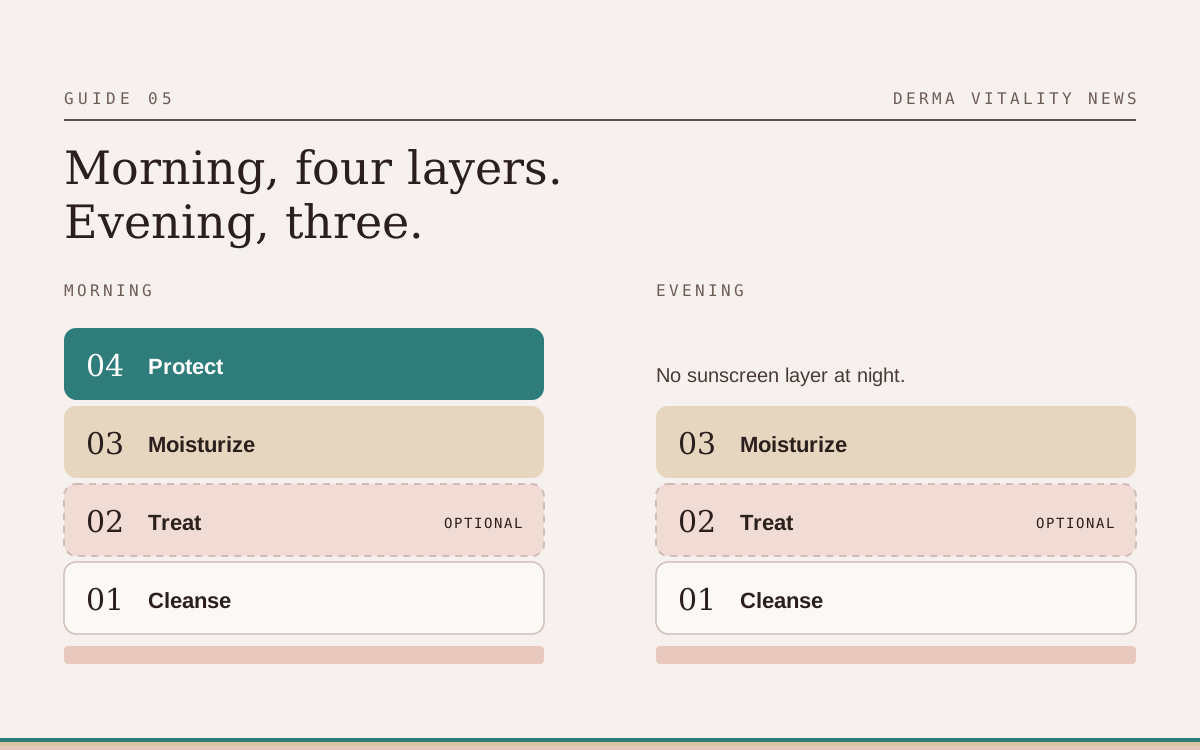
A basic routine has three steps in the evening and four in the morning, and one of them is optional. Morning: cleanse, an optional serum, moisturizer, then broad-spectrum sunscreen last. Evening: cleanse, an optional serum, moisturizer. Everything below explains the order and the few habits that go with it. None of it promises a result; it's a sequence you can keep.
The habits that apply to every step
The American Academy of Dermatology's (AAD) face-washing advice is short, and it sets the tone for the whole routine [1]:
- Use a gentle, non-abrasive cleanser that doesn't contain alcohol.
- Wet your face with lukewarm water and apply the cleanser with your fingertips; a washcloth or mesh sponge can irritate skin.
- Don't scrub. Rinse with lukewarm water and pat dry with a soft towel.
- Wash twice a day, once in the morning and once at night, and after heavy sweating.
- Be gentle around the eyes when applying any cream.
The AAD's dry-skin advice adds two habits worth borrowing: put moisturizer on while skin is still slightly damp, and prefer products labeled "fragrance-free" [2]. Our guide to fragrance-free vs. unscented explains why that label word matters more than "unscented."
Order runs from the thinnest, most watery product to the richest, with sunscreen always last in the morning. That's the logic of this site's four layers. The one fixed rule from regulators is at the end: a sunscreen's own directions tell you when to apply it and when to put more on [4].
The morning sequence
Four steps, about five minutes, with the sunscreen step not up for debate on days you'll be outside.
Cleanse 1 min
Lukewarm water, a gentle cleanser, fingertips, rinse, pat dry, as above [1]. Our 01 Cleanse entries print each cleanser's full label.
Optional serum 30 sec
If you use one, it goes on clean skin, before heavier products, following its label. For example, The Ordinary tells users to apply its Niacinamide 10% + Zinc 1% serum morning and evening, after cleansing and before heavier moisturizers [5]. The brand also suggests using niacinamide and vitamin C products in separate routines [5], a reminder to read each label before stacking serums.
Moisturizer 1 min
On slightly damp skin, massaged in gently [2]. The AAD lists ingredients to look for in a moisturizer: jojoba oil, dimethicone, glycerin, hyaluronic acid, lactic acid, lanolin, mineral oil, petrolatum and shea butter [2]. Then let it settle for a few minutes.
Broad-spectrum sunscreen, last 2 min
The AAD recommends broad spectrum, SPF 30 or higher and water resistant [3]. Use at least 1 teaspoon for the face (about enough to cover the length of your index and middle fingers), on dry skin, 15 minutes before going outdoors, and reapply about every two hours outdoors or after swimming or sweating [6][4]. Include the ears, the back of the neck and the lips, the last with an SPF lip product [4].
"Dry skin" in the sunscreen step is the AAD's wording [6]. It's why the moisturizer gets a few minutes to settle before sunscreen goes over it. There's no official waiting time between the other layers; follow each product's own directions.
The evening sequence
Three steps. At night the wash also takes off the day's sunscreen and sweat, so it's the one step not to skip.
Cleanse 1 min
The same gentle wash as the morning [1]. If your sunscreen label or its brand gives removal directions, follow them.
Optional serum 30 sec
The same serum as the morning if its label says twice daily, or an evening-only product if that's what its label directs. One at a time; see below.
Moisturizer 1 min
On slightly damp skin [2]. The AAD says creams and ointments add more moisture than lotions [2], so a richer cream can make sense in the evening even if you use a lighter one in the morning.
What to drop on a busy day
The serum is the optional layer; skip it first. On a day you'll be outside, keep the sunscreen, since the AAD recommends applying it every day to skin not covered by clothing when you'll be outdoors, noting that UV reaches the ground year-round and passes through clouds [6]. Sunscreen is one part of sun protection, not all of it. The FDA and the AAD both pair it with shade, especially between 10 a.m. and 2 p.m., and with clothing, a wide-brimmed hat and sunglasses [4][6].
A moisturizer or makeup with SPF is convenient, but the AAD's reminder applies: any sunscreen needs reapplying about every two hours when you're outdoors [6].
Keeping the products themselves in good shape
A routine is only as good as what's in the bottles. The FDA's consumer advice covers the small, unglamorous part [8][4]:
- Clean hands, closed lids. Wash your hands before using a product, keep containers clean and tightly closed, and keep them away from temperature extremes [8].
- Watch for changes. Throw a cosmetic away if its color or smell changes [8].
- Date what you open. The law doesn't require cosmetics to carry an expiration date. The FDA suggests marking the container with the date you open it [8].
- Sunscreen is different. As an OTC drug it carries an expiration date unless stability testing shows it lasts at least three years. The FDA says to discard sunscreen past its date, and to treat one with no date as expired three years after purchase [4]. Keep it out of direct sun and heat, as its label directs [4].
If you follow the AAD's amounts (a teaspoon for the face each morning, plus reapplication), a face sunscreen won't sit around for long. The AAD makes a similar point: used every day in the correct amount, a bottle of sunscreen shouldn't last long [6].
Where our catalog fits
Each entry on this site sits in one layer and prints its full ingredient list, so you can match a product to a step: 01 Cleanse for step one of both sequences, 02 Treat for the optional serum, 03 Moisturize for the moisturizer, and 04 Protect for the morning sunscreen and an SPF lip product. We don't rank them against each other; the entries describe the label, the price on the day we looked and where the product goes in the order.
Adding products: one at a time
Build the routine slowly. The AAD recommends testing a new product on a small patch of skin, twice daily for seven to ten days, before adding it [7]. Only one new product at a time means that if something reacts, you know which one it was. Our patch-test guide has the full schedule.
- Cleanser: gentle, non-abrasive, no alcohol, per the AAD [1].
- Moisturizer: "fragrance-free" on the label if you're following the AAD's dry-skin advice [2].
- Sunscreen: "Broad Spectrum SPF" 30 or higher; "Water Resistant (40 or 80 minutes)" if you'll swim or sweat [3]. Our sunscreen label guide explains each phrase.
- Any product: read the directions and warnings before first use [8].
If a product burns, stings or irritates, stop using it. The AAD suggests telling a dermatologist if anything you apply, moisturizer included, causes burning, stinging or irritation, and seeing one if dryness continues after trying its tips [2]. If you use prescription skin products, ask a dermatologist or pharmacist how they fit into these steps. This routine is written for a healthy adult with no known skin condition and isn't medical advice.
Sources
- American Academy of Dermatology. Face washing tips from dermatologists. Accessed Sep 30, 2026. link
- American Academy of Dermatology. Dermatologists' tips for dry skin: damp-skin moisturizing, fragrance-free products, ingredients to look for. Accessed Sep 30, 2026. link
- American Academy of Dermatology. Infographic on selecting a sunscreen. Accessed Sep 30, 2026. link
- U.S. Food and Drug Administration. Consumer page on sunscreen use, application and sun safety (content current as of Sep 10, 2026). Accessed Sep 30, 2026. link
- The Ordinary. Niacinamide 10% + Zinc 1% product page, usage FAQs. Accessed Sep 30, 2026. link
- American Academy of Dermatology. Sunscreen frequently asked questions (last updated Feb 11, 2025). Accessed Sep 30, 2026. link
- American Academy of Dermatology. How to test skin care products at home (last updated Aug 10, 2021). Accessed Sep 30, 2026. link
- U.S. Food and Drug Administration. Using cosmetics safely. Accessed Sep 30, 2026. link
This guide is educational and is not medical advice. Ask a dermatologist, pharmacist or other clinician about anything specific to your skin, especially if a product irritates it or you use prescription skin products.